

Seton Hall Launches New Master of Science (M.S.) in Cybersecurity
Thursday, March 19, 2026
 Seton Hall University is proud to announce the brand-new Master of Science (M.S.) in Cybersecurity program, now taking applications for its inaugural class in Fall 2026. Designed to meet the evolving demands of industry
and technology, the one-year, 30 credit, on-campus program combines technical expertise,
hands-on training and close industry collaboration to equip graduates with the skills
needed to protect digital systems and infrastructure.
Seton Hall University is proud to announce the brand-new Master of Science (M.S.) in Cybersecurity program, now taking applications for its inaugural class in Fall 2026. Designed to meet the evolving demands of industry
and technology, the one-year, 30 credit, on-campus program combines technical expertise,
hands-on training and close industry collaboration to equip graduates with the skills
needed to protect digital systems and infrastructure.
Manfred Minimair, Ph.D., professor in the Department of Mathematics and Computer Science and director of the Center for Cybersecurity, played a central role in developing the program alongside colleague Shajina Anand, Ph.D. Minimair has helped build Seton Hall’s cybersecurity curriculum from the ground up, first establishing undergraduate courses and certification opportunities before expanding to the new graduate-level offering.
“Cybersecurity touches every aspect of our lives,” Minimair said. “Students entering this field need to understand not only how systems work, but how to design them securely.”
Built for Today’s Workforce
The graduate program is structured to serve both working professionals and recent graduates. While many students enroll to advance their current careers in information technology or computing, the program also attracts graduates from STEM fields, IT management and even accounting who are looking to transition into cybersecurity roles.
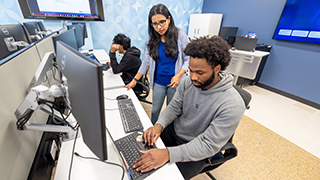 Cybersecurity job vacancies have grown globally, with more than 750,000 cybersecurity
roles unfilled within the United States alone.
Cybersecurity job vacancies have grown globally, with more than 750,000 cybersecurity
roles unfilled within the United States alone.
Unlike programs focused heavily on theory, Seton Hall’s curriculum emphasizes practical, industry-relevant training. The curriculum was developed in collaboration with the university’s Cybersecurity Advisory Board, which includes senior executives from CrowdStrike, Fiserv, MorganFranklin Cyber and more of the top cybersecurity firms in the world.
The result is a practical, career-oriented experience where students learn about emerging threats and technologies while learning the skills and strategies needed to counter those threats. Anand, assistant professor in the Department of Mathematics and Computer Science and assistant director of the Center for Cybersecurity, said that “what excites me most about this program is the opportunity for students to apply what they learn in real time. From penetration testing labs to internships with industry partners, our students will graduate with the confidence and hands-on experience that employers are looking for.”
Hands-On Experience and Real-World Preparation
A defining feature of the program is its strong emphasis on experiential learning. Students participate in ethical hacking and penetration testing exercises, where they learn how to identify and address system vulnerabilities by simulating real cyberattacks in controlled environments.
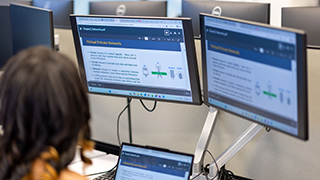 An internship is also another key component of the program, giving students direct
exposure to industry environments and helping them build professional experience before
graduation. The program’s structure — spanning fall, spring and summer semesters —
allows students to complete their degree in one year while gaining valuable hands-on
training.
An internship is also another key component of the program, giving students direct
exposure to industry environments and helping them build professional experience before
graduation. The program’s structure — spanning fall, spring and summer semesters —
allows students to complete their degree in one year while gaining valuable hands-on
training.
Students also benefit from access to Seton Hall’s state-of-the-art cybersecurity laboratory. The lab is equipped with industry-standard tools like Snort, Wireshark, Kali Linux, Burp Suite, Nikto, Metasploit, Nmap, the ELK stack, Splunk, Suricata, OpenVAS and Autopsy, along with virtualized network environments, to practice detecting, analyzing and responding to cyberattacks in a safe, controlled setting.
Supporting Students from Diverse Backgrounds
While many students enter the program with strong technical foundations, faculty provide transition courses for those who may need additional preparation in programming or computing fundamentals. This support ensures that students from a variety of academic and professional backgrounds can succeed in the program.
According to Minimair, students who will thrive in the program are those motivated to advance their careers and apply their knowledge to real-world challenges. The program’s close ties to industry partners help ensure that graduates leave with skills directly aligned with employer expectations.
Inquiries and Applications Now Accepted
As cybersecurity continues to grow in importance, Seton Hall plans to expand and evolve the program to keep pace with technological advances. Minimair expects the program to grow in the coming years and anticipates incorporating new tools and technologies as the field continues to change. Ultimately, the program reflects Seton Hall’s broader mission of preparing students for meaningful careers while addressing critical global challenges.
“Our strength lies in our closeness to industry needs and our emphasis on internships and practical experience,” Minimair said. “We’re preparing students not just to understand cybersecurity, but to lead in the field.”
For a comprehensive look about the University’s cybersecurity offerings, please visit the Cybersecurity Programs and Resources page.
Categories: Education, Science and Technology