
'Leo XIV: The North and South American Pope' Webinar Offered to Journalists and Communications Professionals
Tuesday, April 7, 2026
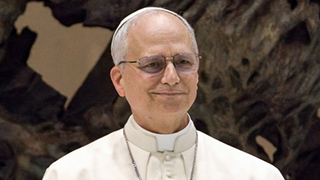
Pope Leo XIV
A missionary, a famously good listener. The first post-World War II pope. Widely traveled, someone who grew up listening to rock-n-roll. A pope of his generation and someone who was sensitive to modern communications. These are some of the descriptors of Pope Leo XIV in the webinar “Leo XIV: The North and South American Pope" offered to journalists and communications professionals on February 20. Seton Hall’s Institute for Communication and Religion (ICR) is a distribution partner for this project. According to ICR Director Jon Radwan, Ph.D., “Sharing research on contemporary faith leadership is a privilege. We are honored to do our part and help everyone learn about Leo XIV!”
The webinar was organized by the School of Church Communications at the Pontifical University of the Holy Cross and Our Sunday Visitor (OSV). Seton Hall Communication adjunct faculty member Colette Liddy said of the event: “I was delighted, that as a member of the Catholic Media Association, I had the opportunity to absorb this inside look at our first American pope featuring commentary by Reverend John Wauck of the Pontifical University of the Holy Cross and Gretchen Crowe, editor-in-chief of OSV News.”
Seton Hall students who study St. Augustine in the University Core and communication, journalism and rhetoric in many of their other courses will find the forum enlightening particularly with the focus on the Holy Father, persuasion and modern communication.
Father Wauck points out that one of the initial times Pope Leo met with journalists last year he connected journalism to his religious order’s founder saying, “In some way communication and journalism do not exist outside time and history. St. Augustine reminds us of this when he said: ‘Let us live well and the times will be good. We are the times.’”
Speaking to the diplomatic corps on January 9, Pope Leo talked about the importance of language. “We need to engage in dialogue ... at the same time, in order to engage in dialogue, there needs to be agreement on the words and concepts that are used,” he said. “Rediscovering the meaning of words is perhaps one of the primary challenges of our time.” His papacy is “a linguistic phenomenon... in a certain sense,” said Father Wauck, due to the pope’s comfort in speaking different languages with ease.
The choice of the name “Leo” invites us to look closely at Leo XIII in order to understand Leo XIV, Reverend Wauck said. Pope Leo has the vision that we are living in a new era, said Father Wauck and has referred to the encyclical Rerum Novarum on Capital and Labor and the dramatic changes in society in the late 1800s connecting them to the impact of artificial intelligence on work, human activity and society today.
The pope’s first World Day of Social Communications message, issued on January 24, focused on artificial intelligence and is anticipated to be the topic of his first encyclical.
Journalists and communications professionals are invited to dive deeper into these issues at the conference “The Church Up Close: Covering Catholicism in the Age of Leo XIV” in Rome, September 7-12, 2026, hosted by the Pontifical University of the Holy Cross in Rome and the non-profit Iscom (the Association for the Promotion of Institutional Communication in Italy).
About the Institute for Communication and Religion
The Institute for Communication and Religion (ICR) is an affiliated unit within Seton
Hall University’s College of Human Development, Culture and Media. Religious traditions are primary drivers for social action across humanity’s full
moral range, from care through violence. Launched with THRUST funding in Fall 2017,
the ICR is an interdisciplinary nexus for communication and media scholarship addressing
the critical intersection between religion and society. Guided by Nostra Aetate’s
spirit of ecumenical and interreligious cooperation, the Institute seeks to engage
in public dialogue and debate, promote academic inquiry and support religious dimensions
of creativity. Our values are Seton Hall’s values: servant leadership, curricular
innovation and intellectual excellence.
For more information, visit the Institute for Communication and Religion website.
Categories: Faith and Service, Nation and World