
Seton Hall Innovators Develop Solutions for Global and Campus Challenges in Second Annual 24-Hour Hackathon
Wednesday, April 22, 2026
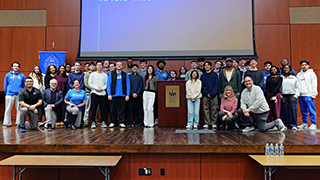
All teams pose for a photo at the second annual Hackathon.
At Seton Hall University, innovation was on full display as students came together for the second annual 24-hour Hackathon, held March 21–22, transforming ideas into actionable solutions for some of today's most pressing global and campus-specific challenges and for the first time, doing so alongside students on the other side of the world.
Held in Jubilee Hall, the event brought together 50 undergraduate and graduate students from across disciplines to collaborate in a fast-paced, high-impact environment, while a parallel Hackathon ran simultaneously at Christ University in Pune, India. From artificial intelligence applications to social impact tools, teams worked around the clock to design solutions addressing issues such as digital security, health access, financial inclusion and student life on campus.
The Hackathon emphasized not only technical development, but also critical professional competencies, teamwork, communication, adaptability and strategic thinking. Students from business, computer science, healthcare and the humanities contributed diverse perspectives, reinforcing the value of interdisciplinary collaboration in solving complex problems.
The event was made possible through the efforts of a dedicated interdisciplinary team. Victor Gomez, director of Esports and adjunct faculty member at the Stillman School of Business, served as lead organizer and project manager. He was joined by Mark Schild, associate dean of the Stillman School of Business; Mary Kate Naatus, dean of Continuing Education and Professional Studies; Manfred Minimair, professor and director of Computer Science, Cybersecurity and Data Science and Engineering; and Sandro Tejada, director of Development, Parents and Families.
"This event is about creating space for students to think boldly and act quickly," said Gomez. "In just 24 hours, they move from concept to prototype, while learning how to collaborate across disciplines and respond to real-world challenges. That's the kind of experience that prepares them for what comes next."
Throughout the event, participants received guidance from faculty, alumni and industry mentors, who provided feedback on both technical execution and real-world applicability. Among them was keynote speaker Michael Spaeth, a Seton Hall alumnus and Vice President of the U.S. Artificial Intelligence Institute, who praised the event for its energy, organization and the coordination between the two university campuses. Final presentations were evaluated based on innovation, feasibility and impact, highlighting solutions that not only demonstrated technical strength but also addressed meaningful societal and campus needs.
When the 24 hours were up, four teams rose to the top:
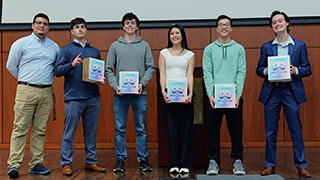
Team Calculator poses for a photo
First Place — Team Calculater Janice Huang, Joseph Calle, Thorin Collins, Victor Li, William Martin
The team’s focus was on privacy risks in conflict areas and we developed "Calculater" - a solution designed to navigate sensitive data exposure in high-risk environments with more discretion and adaptability. It is a video messaging app that allows for invite links to be embedded in photos and the application itself disguises and functions like the calculator app.
Second Place — Team CryptoSecure Farah Baijnath, Hayden Keeperman, Ifeoma Ejikeme, Joshua Albert, Michael Neale
This team's focus was on increasing awareness and giving tools for crypto investors to keep their wallets and investments safe. With call detection to alert investors in real time to potential spam calls and messages.
Third Place — Team PirateFlow Benedykt Kosiek, Joseph Lodge, Victor Flores Valiente, Marco Ponce, Liam Triebenbacher, Amira Batekh, Bassal Jabarin
PirateFlow is an AI trained camera program that monitors not only the flow of traffic to spaces, but also using a localized data base of faces, like an office ID system, can alert security if there is anyone who is not supposed to be present on premise or a room. This empowers event centers, offices and universities to focus on not only the amount of usage a space gets by counting unique visitors, but also adds a layer of security.
Honorable Mention — Team LoanLens Alexander Gimourginas, Jonathan Merlis, Joseph Sager, Matthew Gupta, Sander Dawson
LoanLens sought to redefine the way students take into account loan repayment and planning whether its undergrad and taking FAFSA into account or grad school and factoring in deferment. The group made a chatbot tp go along with the website/app idea to assist in leading lenders to resources.
Beyond the competition, the Hackathon fostered a strong sense of community. Students supported one another through long hours of development, worked alongside industry and faculty mentors who volunteered their time and built connections that extended well past the closing presentations and across borders. "The 24-Hour Hackathon was something truly special, bringing together teams not just from the Seton Hall community, but across the globe...can't wait for the next one!" said Thorin Collins, an IT Management major in the 3+3 Law program. For Collins, the win was part of a banner year, as he also took home the logo design competition in 2026 and marked his second Hackathon at Seton Hall, both times as a member of the first-place team.
As Seton Hall continues to expand transformational learning experiences for students as a key component of the Strategic Plan, the Hackathon stands out as a powerful example of how academic innovation can be translated into real-world impact, preparing students to lead, adapt and solve problems in an increasingly complex global landscape.
Categories: Campus Life, Education, Science and Technology