
Teaching for the Whole Person at Seton Hall: Justin Anderson on Moral Theology and the Search for Meaning
Tuesday, March 10, 2026

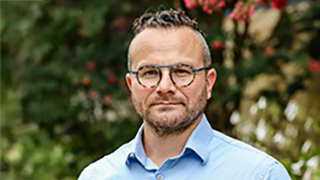
Justin M. Anderson, Ph.D., Professor and Chair of Moral Theology at Immaculate Conception Seminary School of Theology
Justin M. Anderson, Ph.D., a professor and chair of Moral Theology at Immaculate Conception Seminary School of Theology (ICSST) at Seton Hall University, studies ethics with a perspective that is both scholarly and deeply human. “I’m involved in ethics and moral theology, so it’s a practical look at our lives, a search for meaning and ultimately an effort to better the world around us,” he says.
Anderson’s recent books include the forthcoming Aquinas’s Summa and Jesuit Ethics: A Call for Ressourcement (2026), Thomas Aquinas and Medieval Canon Law (2025), Ignatius of Loyola and Thomas Aquinas: A Jesuit Ressourcement (2024) and The Roman School: Nineteenth-Century Jesuit Theology and Its Achievements (2024). In everyday terms, his scholarship explores how the Church's great thinkers and the traditions surrounding them can illuminate contemporary life. By returning to foundational sources — what theologians call ressourcement — his work reflects on how inherited wisdom can renew the ways we learn and teach, live and serve.
At ICSST, Anderson sees that vision come to life where research and teaching meet. “I love being in the classroom and I love doing research as well,” he says. “Those are the two things I would most want to devote my time to. If someone told me, ‘Hey, you just won the lottery,’ my first question would still be, ‘Can I keep teaching? Can I still do my research?’”
Rather than viewing scholarship and teaching as separate obligations, he sees them as parts of the same intellectual rhythm and emphasizes their integration. “I see them as creating a real synergy,” he explains. “My teaching is better when I’m actively researching, and to be perfectly honest, we learn so much when we’re teaching.” The two, he adds, “can both, like a good fire, catch fire and inflame one another.”
Over time, that interplay has shaped the classroom experience at ICSST. “After a few years, you find yourself thinking, my goodness, my students are incredibly insightful,” Anderson says, noting that a number of his students have gone on to publish their own work. Those students include seminarians, members of religious communities and lay students, many of whom, he says, are “on their own journey, serving the people they came to serve.”
A central value of teaching at ICSST, he adds, is the belief that education engages the whole person. In Anderson’s view, this captures the deepest meaning of a liberal arts education: “the formation of the whole person, not just information, but formation.”
In the classroom, he believes every voice matters. “There is always someone here who has something to say to all of us,” Anderson says, adding that educators must remain “attentive to the wisdom that comes to us,” even when it emerges from the quietest voices in the room.
That culture of conversation and shared learning is also reflected in the learning spaces that bring the Seton Hall community together. Anderson points to a “wonderful, well-curated shelf in Walsh Library,” where faculty books are discovered and celebrated, transforming scholarship into a shared invitation for dialogue.
For Anderson, moral theology cannot remain confined to academic debate alone. “We can’t stay locked in a room,” he says. Instead, theology should remain outward facing, attentive to the questions and experiences that shape everyday life. Catholic moral theology, he explains, involves “a kind of dance about how we engage well, as disciples of Jesus Christ, with the world.” At its heart lies a fundamental question: “As a disciple of Christ, how do we encounter the world and the issues unfolding around us?”
The answer, he suggests, lies in openness and movement rather than retreat. Echoing the Gospel’s call to mission, “Go into the whole world and proclaim the gospel to every creature” (Mark 16:15), he reflects that “water is best when it’s living and flowing,” inviting scholars to be willing “to go out into the streets.”
Anderson also reflects on the evolving landscape of higher education. “I use AI,” he says, acknowledging that new technologies can be helpful when approached thoughtfully. “But you have to be careful how you use it,” he explains, because it should remain “a tool that helps you, not something that replaces reflection.” Education, Anderson adds, ultimately means “to lead us out,” drawing on the Latin root ex ducere — to bring us beyond ourselves and into a wider universe, a university.
He closes with gratitude and encouragement for the Seton Hall community. “I’m very encouraged by what I see here,” he says, noting the many “stellar people” he encounters across campus. Looking ahead, Anderson encourages the community not only to strive for excellence but also to pause and recognize what has already been accomplished. Sometimes, he suggests, it is worth “stepping back and looking at what's already been done.” Such reflection, he says, can become “food for the journey.”
To hear more from Anderson in his own voice, listen to his full conversation with Alan Delozier, D.Litt., Humanities and Outreach librarian at Walsh Library, on the Seton Hall University Libraries Zet Forward Podcast. The series brings together members of the University community — students, faculty, administrators and other guests — whose work continues the shared search for meaning that animates the life of Seton Hall and its engagement with the world.
Categories: Education, Faith and Service